Hand and wrist pain can make everyday tasks hard, from typing or opening a jar to lifting a baby or gripping a racket. It might start after a fall, an injury or an operation, or build up slowly over time. At Mint, hand and wrist problems are seen by Alex Watson, our specialist hand therapist, who has worked only with hands and wrists for the past 11 years.
Some common reasons for hand and wrist pain include
- Carpal tunnel syndrome: Pressure on a nerve at the wrist can cause numbness, tingling or weakness in your thumb and fingers, often worse at night.
- De Quervain’s tenosynovitis: Pain on the thumb side of the wrist, often worse when gripping, lifting or twisting. It can come on after lots of repetitive lifting, such as carrying a young baby.
- Trigger finger: A finger or thumb that catches, clicks or locks when you bend it. Therapy and a splint can help, and if it doesn’t settle we’ll refer you to a surgeon.
- Arthritis: Osteoarthritis, often at the base of the thumb, and rheumatoid arthritis can cause pain, stiffness and swelling. We’ll help you manage your symptoms, with splints where they help and advice on adapting everyday tasks.
- Wrist sprains and ligament injuries: A fall onto your hand or a sudden twist can injure the ligaments of the wrist, including the TFCC on the little-finger side.
- Finger and thumb injuries: Mallet finger, sprains, dislocations and skier’s thumb, often from sport or a fall.
- Broken hand or wrist: Rehabilitation to get your movement and strength back after a fracture, whether it was treated in a cast or fixed with surgery.
- Recovery after hand surgery: Including tendon repairs, surgery for Dupuytren’s contracture and thumb base joint surgery. Rehabilitation after a tendon repair can start from 5 days after your operation.
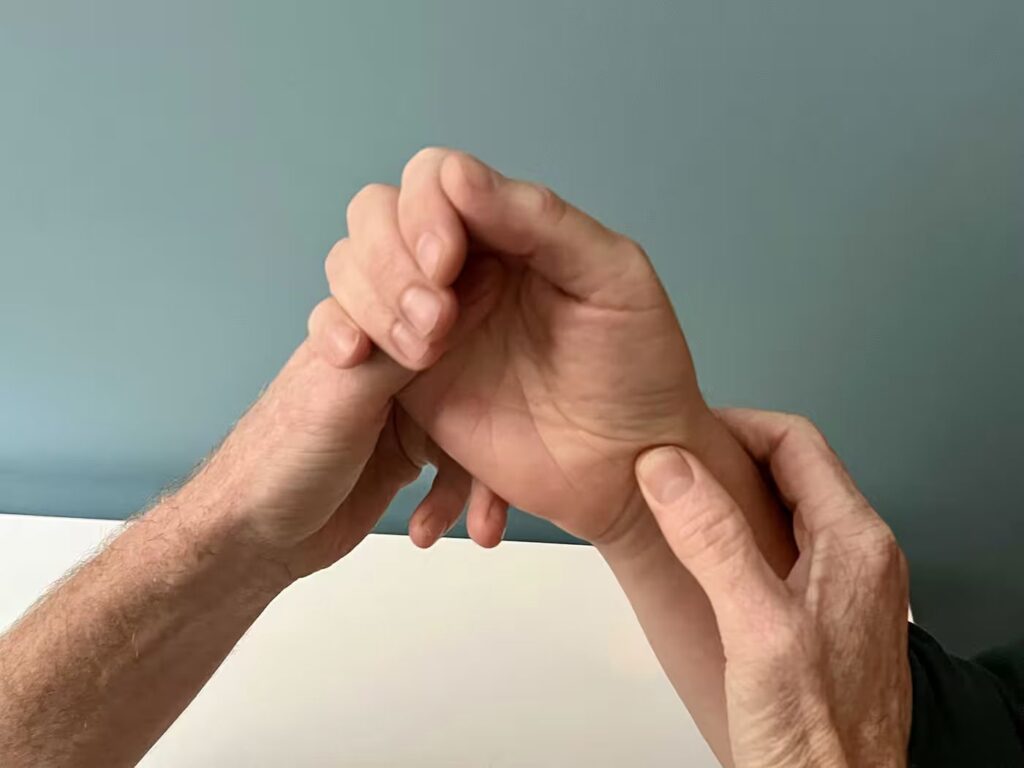

Hand therapy for hand and wrist pain
What we do depends on the cause, but treatment can include:
- A thorough assessment to find out what’s causing your pain
- A home exercise programme tailored to you
- Custom splints, made for you in the clinic
- Taping
- Scar management after an injury or operation
- Advice on how you use your hands at work and at home
- Therapeutic ultrasound
Who you’ll see
Alex has more than 20 years of clinical experience, and for the past 11 years he has worked only with hands and wrists. He makes custom splints for his patients in the clinic, and he’s a member of the British Association of Hand Therapists.
Frequently Asked Questions
Do I need a GP referral?
No. You can book directly with our hand therapist. If you’re claiming on health insurance, check with your insurer first, as some ask for a GP referral before they’ll cover treatment.
How much does it cost?
We recommend a 45-minute appointment (£125) to start with. Follow-ups can be 30 minutes (£86), and a 60-minute appointment is £150. See all our prices.
Will I need a splint, and does it cost extra?
Not everyone needs one. If a splint will help, Alex makes it for you in the clinic, fitted to your hand. Splints cost extra, from about £10 to £50 depending on the size. Contact us for more information.
What’s the difference between a hand therapist and a physiotherapist?
A hand therapist is an occupational therapist or physiotherapist who has done further specialist training in the hand, wrist and arm. Alex is an occupational therapist who has worked only with hands and wrists for the past 11 years.
How many appointments will I need?
It depends on the problem. Some people need only one or two appointments for advice, exercises or a splint. Recovery after surgery or a broken bone usually takes longer, with appointments over several weeks. Alex will tell you what to expect at your first appointment.
How soon after hand surgery can I start?
After a tendon repair, rehabilitation can start from 5 days after your operation, as long as we can see your operation notes and the wound doesn’t need highly specialist care. For other operations, book as soon as your surgeon says you’re ready for therapy.